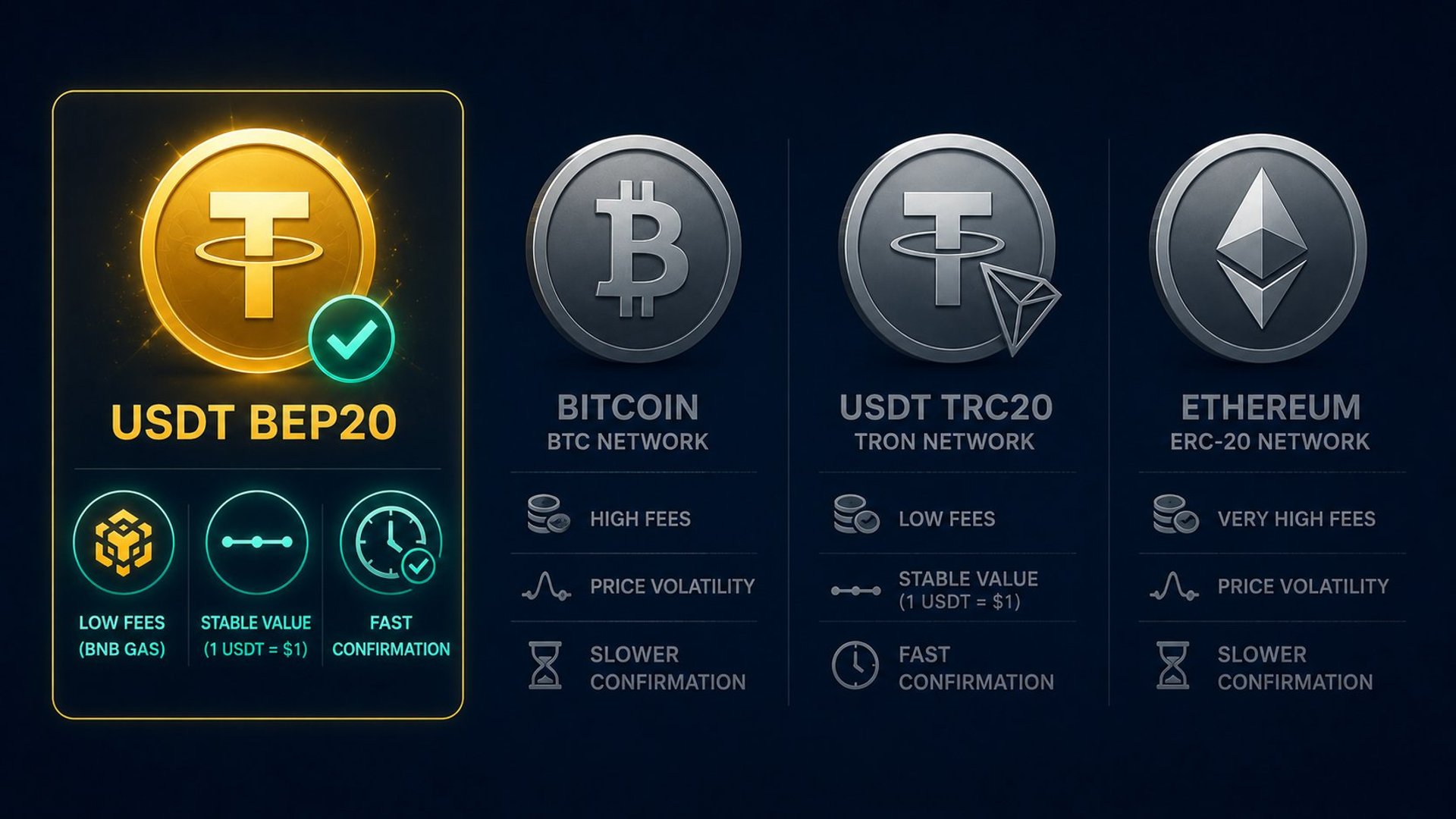
Why CryptoPot Uses USDT BEP20 — and Not Bitcoin, TRC20, or Ethereum
Every crypto lottery has to pick a currency. Here's why we picked this one.
When building a weekly lottery that pays out automatically every Sunday, the choice of currency is not cosmetic. It affects prize stability, gas fee reliability, payout speed, and the practical experience of every player who enters and every winner who receives a payout.
CryptoPot uses USDT on the BEP20 network (Binance Smart Chain). This was a deliberate choice made by ruling out the alternatives one by one. Here is the reasoning.
Why not Bitcoin?
Bitcoin is the most recognised cryptocurrency in the world. It seems like the obvious choice for a crypto lottery. It is not.
The problem is price volatility. Bitcoin's value can swing 10–20% in a single week — and sometimes much more. For a weekly lottery where tickets are sold Monday through Sunday and the draw happens Sunday evening, this creates a fundamental problem:
- A player buys a $10 ticket on Monday when Bitcoin is at $60,000
- By Sunday the draw runs, Bitcoin has dropped to $50,000
- The "winning numbers" were determined by ticket purchases denominated in USD equivalent — but the pot value has changed
- The jackpot winner receives Bitcoin — but how much? The value shifted during the week
There is no clean way to run a fair, predictable weekly prize structure in a volatile asset. Either the prize amount is uncertain going in, or you introduce complex hedging that adds risk and cost.
A stablecoin solves this entirely. $10 in USDT on Monday is $10 in USDT on Sunday. The pot is exactly what the ticket sales say it is. Every player knows the jackpot size in real dollars before the draw runs.
The same logic rules out Litecoin, BNB, ETH, and any other non-stablecoin. Weekly price swings make them unsuitable for a weekly prize pool.
Why not USDT on Ethereum (ERC20)?
USDT exists on multiple blockchains. Ethereum (ERC20) is the largest and most widely used. The problem is gas fees.
Ethereum gas fees are notoriously unpredictable. During periods of network congestion — which happen regularly — a single USDT transfer can cost $10–$50 or more in ETH gas. For a lottery paying out consolation prizes of $10 USDT, a $15 gas fee to send the prize makes the payout economically absurd.
BEP20 (Binance Smart Chain) gas fees run at a fraction of a cent per transaction — typically $0.01–$0.05. At that cost, even small consolation payouts are completely viable to send individually. The entire Sunday payout batch for a typical week costs less than a dollar in total gas.
Why not USDT on Tron (TRC20)?
USDT TRC20 on the Tron network has very low fees — comparable to BEP20 — and is widely used, particularly in Asian markets. It was a genuine contender.
The problem is the gas token. TRC20 transactions require TRX (Tron's native token) to pay for gas. TRX is a separate cryptocurrency with its own price and supply. To send USDT TRC20 payouts, the platform needs to maintain a reserve of TRX for gas.
This creates an operational dependency: if the TRX balance runs low, payouts stop. Topping up requires a separate purchase of TRX, which introduces its own friction, cost, and timing risk. If a low-TRX situation coincides with a Sunday draw, payouts could be delayed while the reserve is replenished.
BEP20 uses BNB for gas — but BNB is the native token of the Binance Smart Chain and one of the most liquid, widely available cryptocurrencies in the world. A small BNB top-up covers hundreds or thousands of transactions. The risk of running out is near zero, and topping up takes minutes on any major exchange. The operational dependency is dramatically lower.
Why USDT BEP20 specifically
Pulling it together, USDT BEP20 wins on every criterion that matters for a weekly prize game:
| Criterion | Bitcoin | ETH (ERC20) | TRC20 USDT | BEP20 USDT |
|---|---|---|---|---|
| Price stability (stablecoin) | ✗ | ✗ | ✓ | ✓ |
| Low gas fees | ✗ | ✗ | ✓ | ✓ |
| Gas token widely available | — | ✗ | ✗ | ✓ |
| No gas depletion risk | — | Low risk | Higher risk | ✓ |
| Widely supported by wallets | ✓ | ✓ | ✓ | ✓ |
| Consistent payout economics | ✗ | ✗ | ✓ | ✓ |
USDT BEP20 is the only option that is a stablecoin, has near-zero and predictable gas fees, and uses a gas token (BNB) that is stable, widely available, and poses minimal operational risk.
What this means for players
Your ticket price is real. ~$10 USDT means ~$10, not approximately $10 depending on what the market did overnight.
Your winnings are real. When the major winner receives $1,570 USDT, they receive $1,570. Not $1,570 worth of something that was worth $1,570 when the draw ran but might be worth $1,200 when they check their wallet Monday morning.
Payouts always go out. The platform maintains a BNB reserve for gas. That reserve scales with player volume and is sized to cover hundreds of transactions with significant buffer. There is no scenario where Sunday payouts are delayed because the gas token ran out.
Fees are negligible. The total gas cost for sending all winner, consolation, and affiliate payouts in a typical week is under a dollar. This does not meaningfully affect prize amounts.
What you need to participate
You need a USDT BEP20 wallet — one that supports USDT on the Binance Smart Chain. The most commonly used options are Trust Wallet and MetaMask (with the BSC network added).
You also need a small amount of BNB in that wallet to pay for gas on your end when you move USDT. A few dollars of BNB covers hundreds of transactions.
Step-by-step wallet setup guide →
Ready to enter?
Draw every Sunday at 8:00 PM Atlantic Standard Time (AST). Ticket sales close at 6:00 PM AST. All payouts sent in USDT BEP20 via NOWPayments to registered wallet addresses.
Enter This Week's Draw
Pick 5 numbers from 1–35. Tickets close Sunday 6 PM AST — draw at 8 PM.
Enter Now