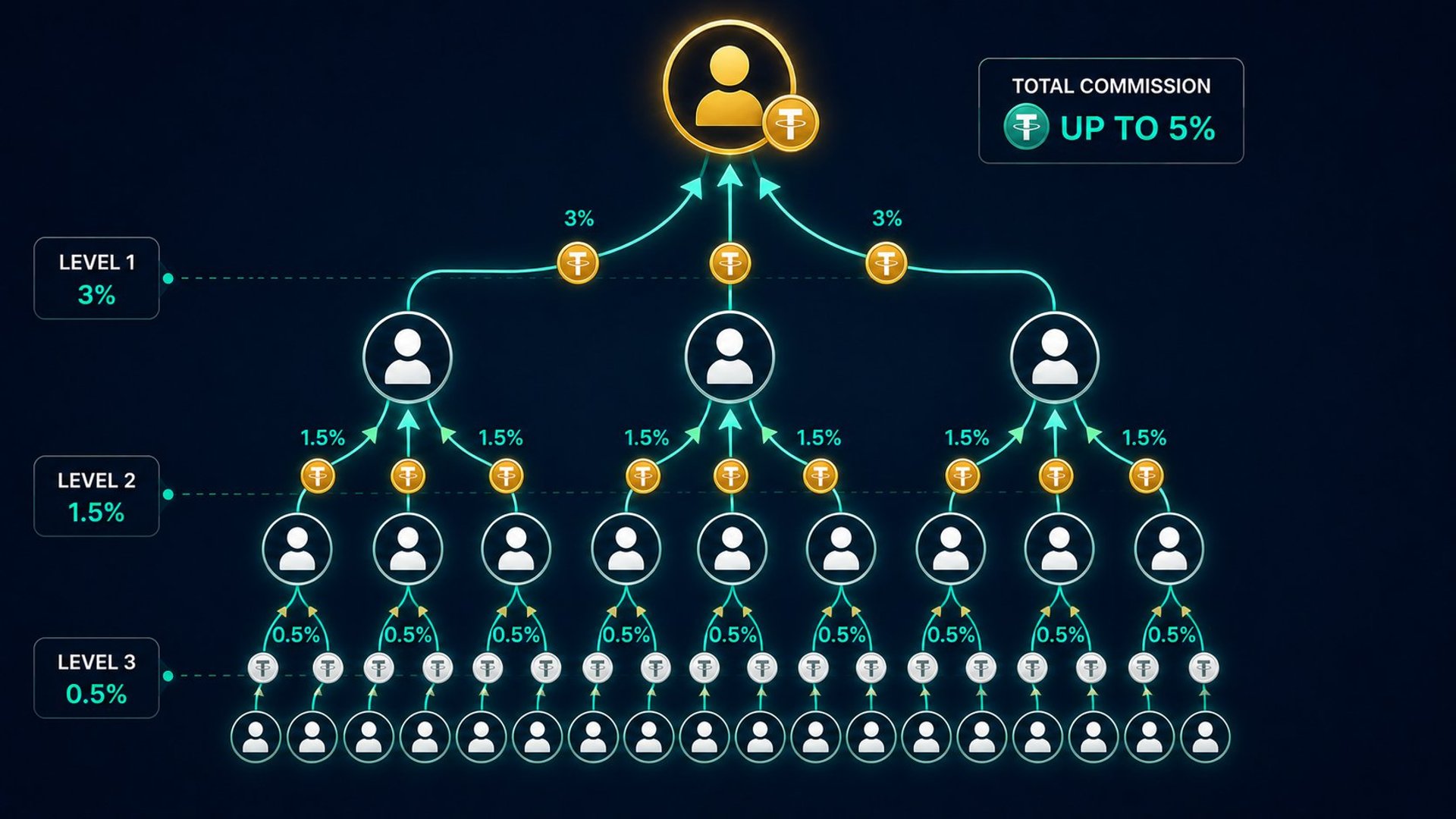
How CryptoPot's Multi-Tier Affiliate Program Works — and Why It Pays More Than Going Solo
Two ways to earn. You choose which one.
Every CryptoPot account comes with a referral link automatically. By default, it works on a single-tier basis: you refer someone, they play every week, you earn 5% of every ticket they ever buy — automatically, every Sunday in USDT. That is already a strong model and most affiliates will find it sufficient.
But there is a second option: multi-tier. Switch it on in your affiliate dashboard and your referral network can go three levels deep — earning you a share of what your recruits' recruits spend, not just your direct referrals.
This article explains exactly how multi-tier works, what the rate table looks like, and — critically — shows the real earnings difference between going solo and building a network.
The rate table
The total affiliate pool is always 5% of every ticket sold by referred players. Multi-tier does not increase the pool — it splits it across the chain. The rate structure depends on how deep the active chain is at any given point:
| Chain depth active | L1 — you (direct referrer) | L2 — your recruit | L3 — their recruit |
|---|---|---|---|
| Single-tier (default) | 5% | — | — |
| 2 levels active | 3.5% | 1.5% | — |
| 3 levels active | 3% | 1.5% | 0.5% |
Key point: the percentages always add up to 5%. When you enable multi-tier, you trade some of your direct earnings rate for the ability to earn from deeper levels of your network. Whether that trade is worthwhile depends on how many people you can recruit — which is exactly what the earnings comparison below shows.
How the chain works in practice
When you enable multi-tier in your affiliate dashboard, players who sign up through your link inherit multi-tier status by default — meaning they can also recruit and build their own Level 2 chains under you.
- Your direct referrals are Level 1 — you earn 3% of their ticket purchases
- Players they recruit are Level 2 — you earn 1.5% of those players' ticket purchases
- Players Level 2 recruits bring in are Level 3 — you earn 0.5% of those players' ticket purchases
The chain is hard-capped at 3 levels. There is no Level 4. This is a deliberate design decision — it keeps the structure simple and avoids the regulatory and ethical concerns of unlimited-depth MLM structures.
Anyone in your chain can opt back to single-tier at any time. If they do, the chain stops at them — you keep earning your direct rate on their own ticket purchases, but you no longer earn from anyone they recruited. Their decision does not affect your earnings from your other recruits.
Solo vs. network: the earnings comparison
Tickets are ~$10 USDT each. Here is what the numbers look like across different scenarios — the same number of total active players in your network, but structured differently.
Scenario A: 20 direct referrals, single-tier
You referred 20 players directly. Each buys 2 tickets per week.
| Level | Players | Tickets/week | Your rate | Your weekly earnings |
|---|---|---|---|---|
| L1 (direct) | 20 | 2 each = 40 | 5% | $20.00 |
| Total | $20.00/week | |||
| Annual | $1,040/year |
Scenario B: 20 direct referrals, multi-tier enabled — they each recruit 3
You have the same 20 direct referrals. Each of them recruits 3 players. Those 60 L2 players each recruit 2 players, giving you 120 at L3. Everyone buys 2 tickets per week.
| Level | Players | Tickets/week | Your rate | Your weekly earnings |
|---|---|---|---|---|
| L1 (your direct) | 20 | 2 each = 40 | 3% | $12.00 |
| L2 (their recruits) | 60 | 2 each = 120 | 1.5% | $18.00 |
| L3 (their recruits) | 120 | 2 each = 240 | 0.5% | $12.00 |
| Total | 200 players | 400 tickets | $42.00/week | |
| Annual | $2,184/year |
Same 20 direct referrals. Network earnings are 2.1× higher than solo earnings — with no extra direct effort after the initial recruits start referring.
Scenario C: Conservative network — 10 direct, each recruits 5, L2 each recruits 2
| Level | Players | Tickets/week | Your rate | Your weekly earnings |
|---|---|---|---|---|
| L1 | 10 | 2 each = 20 | 3% | $6.00 |
| L2 | 50 | 2 each = 100 | 1.5% | $15.00 |
| L3 | 100 | 2 each = 200 | 0.5% | $10.00 |
| Total | 160 players | 320 tickets | $31.00/week | |
| Annual | $1,612/year |
Compared to 10 direct referrals on single-tier earning $10/week ($520/year), the network model at the same direct referral count yields 3× more annually.
Scenario D: At scale — 50 direct referrals with active L2 and L3 chains
| Level | Players | Tickets/week | Your rate | Your weekly earnings |
|---|---|---|---|---|
| L1 | 50 | 2 each = 100 | 3% | $30.00 |
| L2 | 150 | 2 each = 300 | 1.5% | $45.00 |
| L3 | 300 | 2 each = 600 | 0.5% | $30.00 |
| Total | 500 players | 1,000 tickets | $105.00/week | |
| Annual | $5,460/year |
When single-tier is still the better choice
Multi-tier is not automatically better for everyone. It makes sense to stay on single-tier if:
- You refer players directly but do not recruit other affiliates. If none of your referrals are themselves going to recruit anyone, enabling multi-tier just reduces your L1 rate from 5% to 3% with no benefit. Stay on single-tier.
- You prefer simplicity. Single-tier is one number: 5% of every ticket your referrals buy, forever. No chain to track, no tier logic to explain to recruits.
- Your audience is players, not promoters. If you share your link with friends, family, or a social media audience who are interested in playing — not in building their own referral income — single-tier earns you more per referral.
The switch to multi-tier pays off when you have recruits who are themselves motivated to share and grow their own networks. That multiplier effect is where the L2 and L3 earnings become meaningful.
How to switch between modes
The multi-tier toggle is in your affiliate dashboard. It shows the rate comparison table side by side so you can see exactly what you gain and give up before switching. You can switch back to single-tier at any time — your existing referral relationships are not affected.
When multi-tier is active, your registration page automatically shows new sign-ups an explanation of the chain, the 3% direct rate, and how to opt out if they prefer single-tier. Transparency is built into the signup flow.
What stays the same regardless of tier mode
- Permanent referral binding. Every player you refer is yours for life — their 5% pool contribution flows to your chain forever, regardless of whether you are on single or multi-tier
- Sunday payouts. Earnings are calculated at draw time every Sunday and paid automatically in USDT BEP20 to your registered wallet via NOWPayments — no manual steps, user adjustable withdrawal threshold
- One consolidated payout per week. All your L1, L2, and L3 earnings for the week are batched into a single transfer
- Earnings history by tier. Your dashboard shows a full breakdown of which level each earning came from, so you can see exactly how your network is performing
Getting started
Every CryptoPot account already has a referral link. Log into your dashboard, find the affiliate section, and the multi-tier toggle is there when you are ready to use it.
If you do not have an account yet, registering takes a few minutes — your referral link, QR code, and promotional materials are available immediately after signup.
Create your account and get your referral link →
Already have an account? Log in and check your affiliate dashboard to see your current earnings and toggle multi-tier on or off.
Affiliate earnings paid every Sunday at draw time in USDT BEP20 via NOWPayments. Multi-tier chain hard-capped at 3 levels. Total affiliate pool is always 5% of referred players' ticket purchases — split across active chain levels. How the full draw and payout process works →
Enter This Week's Draw
Pick 5 numbers from 1–35. Tickets close Sunday 6 PM AST — draw at 8 PM.
Enter Now